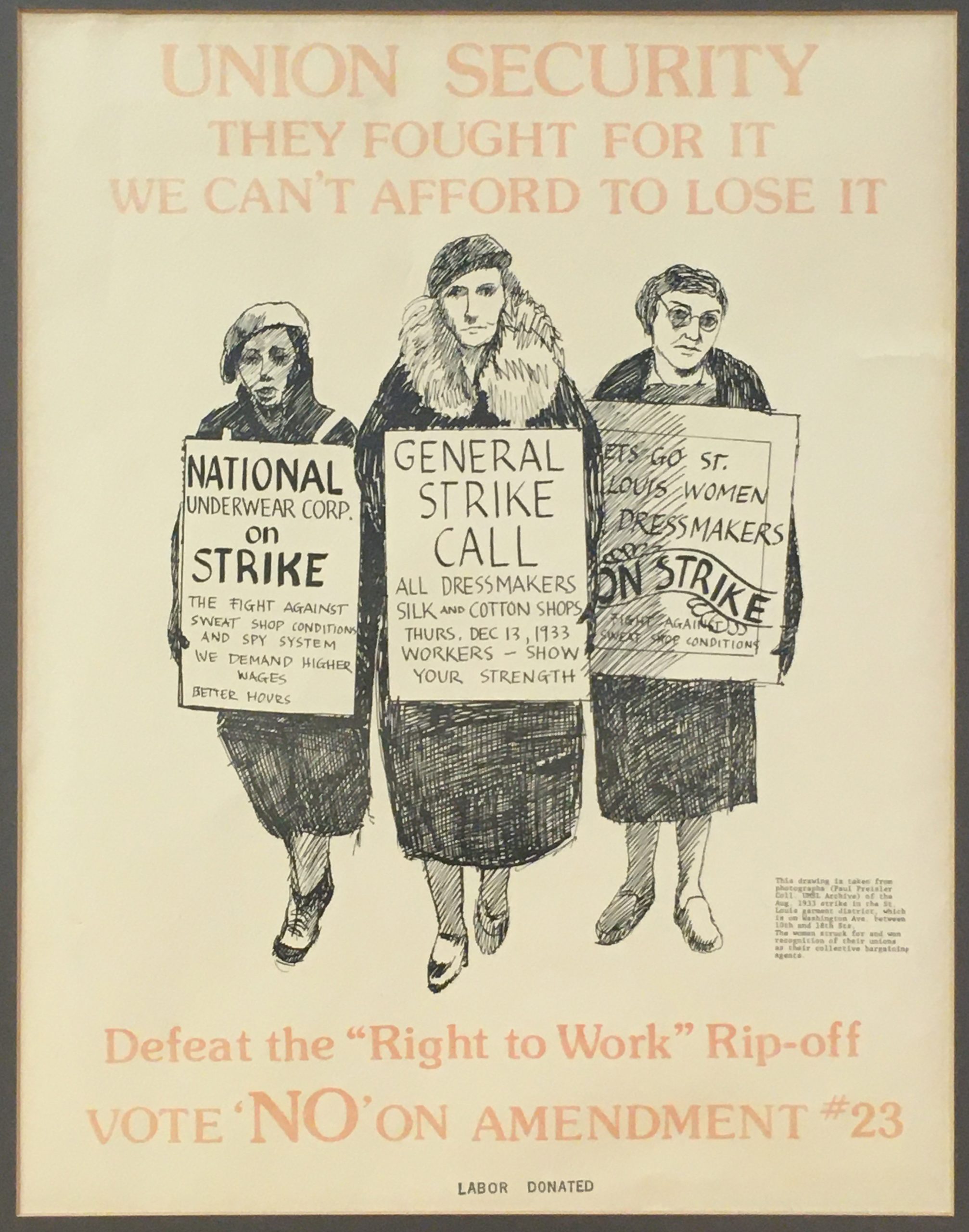
This poster urged Missourians to vote “no” on Amendment 23. If approved, the measure slated for the November 1978 election would have added verbiage to the State Constitution prohibiting collective bargaining contracts requiring union membership and dues as a condition of employment. The piece depicts an image of the 1933 Strike in St. Louis’ Garment District, highlighting the women who fought for the right to unionize. The poster creators ultimately evoke Missouri’s long tradition of labor organizing to defend unions and worker protections at a critical moment.
Proponents of the “Right-to-Work” law believed a victory in a highly unionized state like Missouri would create a domino effect to undermine labor union power in the Midwest. By August 1978, the measure led in the polls by a 2-1 margin. Although predicted to pass, a statewide multiracial coalition of union members, farmers, community activists, religious leaders, students, women’s groups, and environmentalists created a robust campaign to defeat Amendment 23. Activists, led by St. Louisan Jerry Tucker, launched voter registration drives, voiced their perspectives through media outlets, organized rallies, and educated Missourians about the state’s labor history and union power. On November 7, 1978, voters overwhelmingly rejected the Right-to-Work measure by a 60-40 percent margin.
The defeat marked a significant victory in the 1970s, a period of loss for the labor movement. Deindustrialization, automation, outsourcing, and a faltering economy led private interests and conservative politicians to build an anti-labor movement that promoted unions as a burden to industry and economic growth. These policies have weakened labor unions, although their influence and power remain. In 2018, Missouri voters overturned a Right-to-Work law through a ballot referendum. Despite union membership declining across the country, the state’s labor movement history continues to shape Missouri’s politics.